PR cycle time is the time it takes for a pull request to move from opening to merging. It may seem small, but it affects how quickly your team can ship changes, fix bugs, and respond to users.
In this article, we’ll explain what PR cycle time means, why it matters, and how to improve it without rushing reviews.
What Is PR Cycle Time?
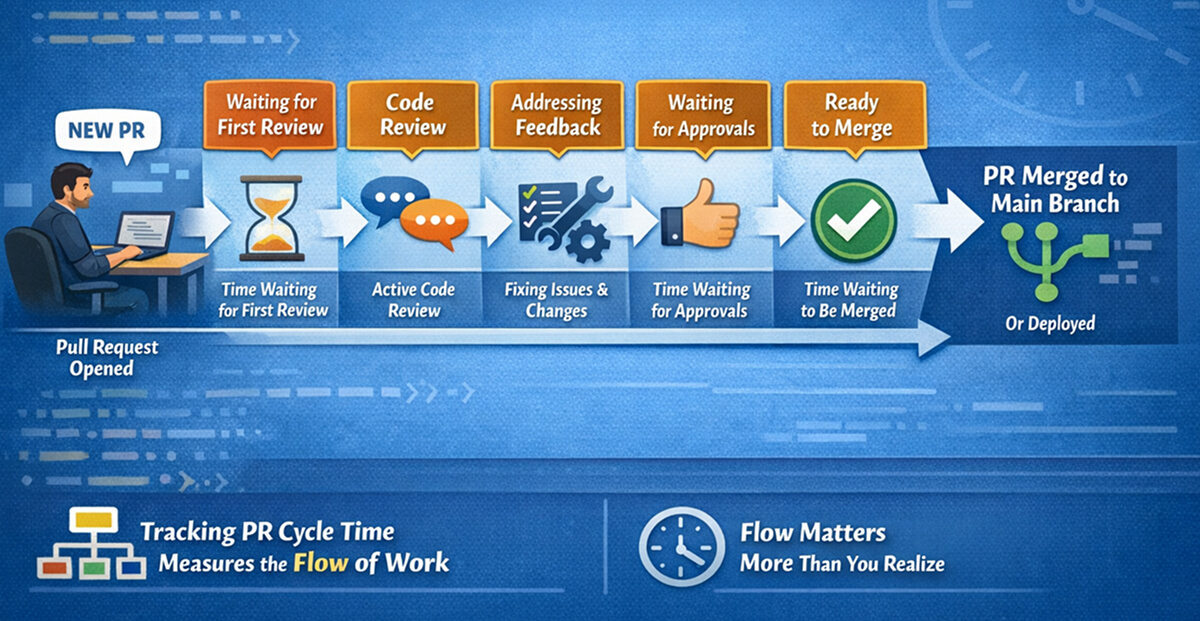
PR cycle time, also called pull request cycle time, measures how long a pull request takes to go from creation to merge.
In most teams, this clock starts when a developer opens a pull request and stops when that pull request is merged into the main branch. Some tools also include the time until deployment, depending on how the metric is defined.
At a high level, PR cycle time includes:
- Time waiting for the first review.
- Time spent in active code review.
- Time spent addressing feedback.
- Time waiting for approvals.
- Time waiting to be merged.
It does not try to judge code quality. It simply measures flow.
And flow matters more than many teams realize.
Why PR Cycle Time Matters
Fast teams are not fast because developers type faster. They are fast because work moves smoothly.
PR cycle time tells you how smoothly work moves through your system.
Shorter cycle times usually mean:
- Faster feedback loops.
- Less context switching.
- Fewer merge conflicts.
- Lower cognitive load on reviewers.
- Quicker delivery of value.
Long cycle times often signal hidden problems. Not bad developers, but friction.
Common friction points include unclear ownership, overloaded reviewers, large pull requests, or too many approval steps.
If you want a deeper definition of how teams measure this, pull request cycle time is clearly explained in Swarmia’s metrics documentation.
PR Cycle Time vs. Code Review Cycle Time
These two terms are often used interchangeably, but they are not the same.
Code review cycle time focuses only on the review phase. It usually starts when the first reviewer is requested and ends when the review is completed or approved.
PR cycle time is broader. It includes everything from PR creation to merging.
Think of it this way:
- Code review cycle time asks, “How fast do we review?”
- PR cycle time asks, “How fast does a change actually land?”
Both are useful. PR cycle time gives you the bigger picture.
How PR Cycle Time Relates to Change Lead Time
You may also have heard the term change lead time, especially in DevOps and DORA metrics.
Change lead time measures how long it takes for a code change to go from commit to production. PR cycle time is one part of that journey.
A simplified flow looks like this:
- Code is written.
- A pull request is opened.
- Code is reviewed and merged.
- Code is deployed.
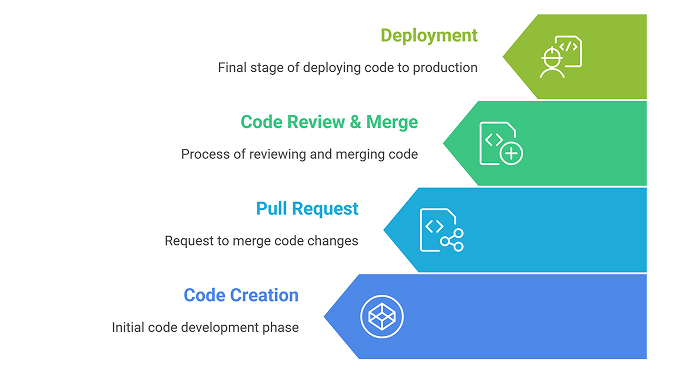
PR cycle time lives in steps 2 and 3. If pull requests move slowly, the change lead time increases, even if the deployment itself is fast.
This is why many high-performing teams tend to prioritize pull requests over optimizing deployment pipelines and CI.
What Is a Good PR Cycle Time?
This is the question everyone asks, and the honest answer is: it depends.
A small startup with a single reviewer will have a different baseline than a regulated enterprise with strict compliance checks.
That said, many healthy teams aim for:
- Hours, not days, for small changes.
- One to two days for moderate changes.
- Clear explanations when something takes longer.
What matters more than the absolute number is consistency. If most PRs follow a predictable rhythm, teams can plan more effectively and feel less stressed.
Large spikes or long tails in PR cycle time often point to process issues worth investigating.
Common Causes of Long PR Cycle Time
If your pull requests are moving slowly, it is rarely because people do not care.
More often, it is due to things like:
- Pull requests that are too large to review quickly.
- Unclear expectations for reviewers.
- Review requests sent without context.
- Time zone gaps with no ownership handoff.
- Developers are multitasking across too many PRs.
- Reviews are treated as “background work.”
None of these requires heroic effort to fix; they simply require attention.
Practical Ways to Improve PR Cycle Time
You do not need to overhaul your entire process. Small changes compound quickly.
Here are a few proven practices:
- Keep pull requests small and focused.
- Add clear descriptions explaining the “why,” not just the “what.”
- Set informal SLAs for first review response.
- Rotate reviewers to balance the load.
- Encourage early draft PRs for feedback.
- Limit the number of active PRs per developer.
One simple habit helps more than most tools: reviewing pull requests as part of daily work, not as an afterthought.
Should You Optimize PR Cycle Time Aggressively?
This is an important question.
Chasing lower numbers without context can backfire. Fast reviews that miss issues create rework later, increasing overall lead time and frustration.
PR cycle time should be treated as a health signal, not a target that can be gamed.
Ask questions like:
- Where are PRs getting stuck?
- What kind of PRs take the longest?
- Is the delay due to review, rework, or waiting?
Used this way, the metric supports better conversations, not pressure.
Final Thoughts
It’s understandable to overlook PR Cycle Time in day-to-day dev work. It may not come up in scheduling or daily stand-up meetings. But it influences the way the team operates.
Long-unresolved PRs decrease devs’ mental health and overall productivity. Even if this isn’t a problem or you don’t have the perfect numbers yet, you should understand the difficulties to instill a paradigm shift.
Set goals and analyze cycle times. It’ll help you identify and work toward constant improvements, leading to increased distribution in team velocity and lower lead time in software delivery.